


After the classic to the Company car taxation Today I would like to shed light on another "evergreen" of employee taxation:
The taxation of severance payments.
Especially since it will be incredibly difficult for the layman to understand how the fifths rule works. And this despite the fact that you can save considerable taxes with this regulation. In addition, I give a compact guide on where the information must be made in the tax return.
1. What is severance pay?
Severance pay is usually paid in direct connection with the loss of an employment relationship. This can be done on the basis of a voluntary agreement between employer and employee (termination agreement) or be the result of an employment law process after termination (settlement). The amount of the severance payment is freely negotiable. In practice, however, a value of 0.5 to 1 gross monthly salary per year of employment has become the benchmark. A labour judge will also be guided by this value (§1a para. 2 KSchG).
The salary to be used as a basis is usually made up of all celebrate and variables components, e.g.:
- Gross salary
- Holiday and Christmas bonus
- Company car
- Other contractual commitments (pension schemes, subsidies, etc.)
- Target agreement and royalties (averaged over three years, if applicable)
Of course, it is in the nature of things that the interests diverge here. An employer will usually try to add as few salary components as possible. The employee, on the other hand, naturally tries to "knock out" the maximum possible. This is also where the greatest negotiation potential for both sides will lie.
2. How is the severance pay taxed? Save taxes through the one-fifth rule?
A severance payment is taxable as wages if it is received. In other words, like a normal monthly salary. In order to mitigate this tax burden, tax law, but a provision in §34 EStG ready. The so-called One-fifth rule (manchmal auch als 1/5 Regelung geschrieben).
Bis Ende 2024 hatte der Arbeitgeber die Fünftelregelung zu prüfen und – bei Vorliegen der Voraussetzungen – bereits in der Lohnabrechnung anzuwenden. Seit dem 1.1.2025 ist das nicht mehr möglich: Mit dem Wachstumschancengesetz wurde die Fünftelregelung aus dem Lohnsteuerabzugsverfahren gestrichen (§ 39b Abs. 3 S. 9/10 EStG a. F. aufgehoben). Die Abfindung wird bei Auszahlung voll als sonstiger Bezug dem regulären Lohnsteuerabzug unterworfen. Die Steuerermäßigung nach § 34 EStG bleibt bestehen – aber ausschließlich über die Einkommensteuererklärung.
PRACTICAL NOTE:
In practice, the Employer However, they usually do not have the necessary information for the assessment, so that in almost all cases the higher standard taxation is applied.
In order not to give away money, the employee has no choice but to apply for the Income tax return (§46 para. 2 no. 8 EStG). I'll show you how to do that below.
Seit 2025 gilt das ausnahmslos: Der Arbeitgeber behält auf die Abfindung die volle Lohnsteuer ein (zunächst also ein niedrigeres Netto). Den Vorteil der Fünftelregelung holen Sie sich vollständig über die Einkommensteuererklärung zurück – Sie tragen bis zur Veranlagung nur einen Liquiditätsnachteil.
3. Der steuerliche Abfindungsrechner
DAWICON · Steuerrechner 2025 / 2026
Fünftelregelung-Rechner: Abfindung optimal versteuern
Wie viel Steuern sparen Sie durch die Fünftelregelung nach § 34 EStG? Vergleichen Sie die Besteuerung Ihrer Abfindung mit und ohne Tarifermäßigung – inklusive Progressionsvorbehalt (z. B. Arbeitslosengeld) und Timing-Vergleich.
Ihre Angaben
Ihr Vorteil durch die Fünftelregelung
–
Vergleich: ohne / mit Fünftelregelung
| Position | ohne § 34 EStG | mit § 34 EStG |
|---|---|---|
| Einkommensteuer | – | – |
| Solidaritätszuschlag | – | – |
| Kirchensteuer | – | – |
| Gesamtbelastung im Steuerjahr | – | – |
| davon Steuer auf die Abfindung | – | – |
| effektiver Steuersatz auf die Abfindung | – | – |
| Netto aus der Abfindung | – | – |
Schritt-für-Schritt: So rechnet das Finanzamt (§ 34 Abs. 1 EStG)
Timing-Vergleich: Auszahlung Dezember vs. Januar
Die Fünftelregelung wirkt am stärksten, wenn im Zuflussjahr wenig übriges Einkommen anfällt. Lässt sich die Auszahlung vertraglich ins Folgejahr verschieben (Fälligkeit im Januar statt Dezember), trifft die Abfindung oft auf ein deutlich niedrigeres Einkommen.
Zufluss im Steuerjahr
Zufluss im Folgejahr
Wie stark schmilzt der Vorteil mit steigendem Einkommen?
Vorteil der Fünftelregelung (Steuerersparnis in €) in Abhängigkeit vom übrigen zu versteuernden Einkommen – bei Ihrer Abfindung von –. Der Punkt markiert Ihre Eingabe.
Voraussetzungen & Hinweise
Unverbindliche Modellrechnung, keine Steuer- oder Rechtsberatung. Berechnung nach § 32a EStG
(Tarife 2025/2026), § 34 Abs. 1 EStG inkl. Satz 3 und § 32b EStG (besonderer Steuersatz, auf vier
Nachkommastellen abgerundet); Solidaritätszuschlag mit Freigrenze/Milderungszone
(2025: 19.950 € / 2026: 20.350 €, verdoppelt bei Zusammenveranlagung). Vereinfachungen: Kirchensteuer
pauschal als 8 %/9 % der Einkommensteuer – die Bemessung nach § 51a EStG (Kinderfreibeträge, Kappung)
ist nicht abgebildet; keine Kinderfreibeträge beim Solidaritätszuschlag. Brutto-Modus: Näherung des zvE
über Arbeitnehmer-Sozialversicherungsbeiträge (RV 9,3 %, GKV 7,3 % + ½ Ø-Zusatzbeitrag
[2025: 2,5 % / 2026: 2,9 %], PV 1,8 %; BBG 2025: RV 96.600 € / KV 66.150 €, 2026: RV 101.400 € /
KV 69.750 €), Arbeitnehmer-Pauschbetrag 1.230 € und Sonderausgaben-Pauschbetrag 36 €.
© DAWICON GmbH WpG
4. Muss ich Sozialabgaben auf eine Abfindung zahlen?
The good news: "No". In principle, no social security contributions have to be paid on a severance payment, if the severance pay is paid as "compensation" for the loss of the job. The severance payment may therefore be none Compensation for already "earned" entitlements, for example:
- sales commissions,
- Overtime or vacation entitlement
- Claims from target agreements or royalties, etc.
The same applies to the one-fifth rule. In practice, however, it will usually be difficult to assess a differentiation between the entitlement that has already been "earned" and the severance payment component. Especially if these components have not been contractually stipulated and are unambiguous. If it is unambiguous, however, a division will be made according to "regular earnings" and "severance pay".
5. Was ist die Fünftelregelung?
Tax on severance pay – The one-fifth rule is difficult to understand even for tax specialists from the wording of the law. Would you like an example?
34 para. 1 sentence 2 and sentence 3 EStG
'The income tax to be assessed on extraordinary income shall be five times the difference between income tax on taxable income less that income (remaining taxable income) and income tax on the remaining taxable income plus one-fifth of that income. 3If the remaining taxable income is negative and the taxable income is positive, income tax shall be five times the income tax attributable to one-fifth of the taxable income.'
34 para. 1 sentence 2 and sentence 3 EStG
'The income tax to be assessed on extraordinary income shall be five times the difference between income tax on taxable income less that income (remaining taxable income) and income tax on the remaining taxable income plus one-fifth of that income. 3If the remaining taxable income is negative and the taxable income is positive, income tax shall be five times the income tax attributable to one-fifth of the taxable income.'
In principle, the aim is to Tax burden through a compensation payment mitigating. The severance payment is fictitious spread over 5 years, so to speak, and the applicable tax rate is reduced accordingly. Anyone who receives a severance payment and meets the following requirements can claim the one-fifth rule.
6. Was sind die Voraussetzung für die Anwendung der Fünftelregelung bei der Einkommensteuer?
However, in order for the one-fifth rule to apply, a few prerequisites must be met, which have emerged from the administrative instructions and case law. The severance pay must be a Compensation act (§34 para. 2 no. 2 EStG iVm §24 No.1 EStG)
- than Compensation for lost or lost revenue.
This will usually be undisputed. However, as described above on social security contributions, care must be taken to ensure that these are not entitlements that have already been earned.
- must extraordinary income represent
The fact that the severance payment or compensation constitutes extraordinary income follows directly from the law (§34 para. 2 no. 2 EStG iVm §24 No.1 EStG)
- must clumped together flow to
It is important that the compensation flows in a "cumulative" manner, i.e. in a tax year, which leads to an increased tax burden.
IMPORTANT:
If a severance payment is spread over two or more assessment periods, the reduced taxation under the one-fifth rule is excluded (see Federal Fiscal Court, 21.3.1996 – XI R51/95).
But there is also an exception here. If no more than 10% of the severance payment is postponed to the next year, this is "harmless" for reasons of simplification (see the BMF letter of 4.3.2016).
If a severance payment is spread over two or more assessment periods, the reduced taxation under the one-fifth rule is excluded (see Federal Fiscal Court, 21.3.1996 – XI R51/95).
But there is also an exception here. If no more than 10% of the severance payment is postponed to the next year, this is "harmless" for reasons of simplification (see the BMF letter of 4.3.2016).
7. Wie funktioniert die Fünftelregelung und wie wird sie berechnet?
The 1/5 rule is best applied to a small Example with calculation.
Taxing severance pay - examples
Example 1 - Mr. Max receives 25,000 EUR severance pay on 31.12.
Vereinfachte Darstellung: Das Jahresbrutto wird hier mit dem zu versteuernden Einkommen (zvE) gleichgesetzt; real liegt das zvE nach Vorsorgeaufwendungen und Werbungskosten niedriger. Alle Steuerbeträge nach dem Grundtarif 2026 (Einzelveranlagung).
Herr Max ist 50 Jahre alt. Kirchensteuerpflicht besteht nicht. Sein Annual gross salary is EUR 48,000. For the termination of his employment on 31.12. he receives a severance payment of 25.000 EUR.
| I | II | III | |
| Taxation without severance pay | Taxation with severance pay | Taxation with fifths rule | |
| Annual gross income | 48.000,00 | 48.000,00 | 48.000,00 |
| Compensation | 0,00 | 25.000,00 | 25.000,00 |
| Total income (taxable income) | 48.000,00 | 73.000,00 | 73.000,00 |
| Steer | 9.852,90 | 19.524,37 | 18.675,67 |
| Tax rate | 20,53% | 26,75% | 25,58% |
| Auxiliary calculation | |||
| Annual gross income without severance pay | 48.000,00 | ||
| + 1/5 of the severance payment of EUR 25,000 | 5.000,00 | ||
| Total Income | 53.000,00 | ||
| Taxes on this | 11.617,45 | ||
| Difference Tax III ./. Tax I | 1.764,55 | ||
| Tax difference between I and III multiplied by a factor of 5 | 8.822,77 | ||
| + Tax without severance pay (I) | 9.852,90 | ||
| Tax on fifths rule | 18.675,67 |
The sub-calculation shows how the one-fifth rule works. Only by applying them does Mr. Max save almost in our example 2% Taxes or 1.411,59 EUR.
So if his employer has not yet applied the one-fifth rule, Mr. Max can reclaim a nice amount with his income tax return and is a beneficiary.
Example 1 - Mr. Max receives 25,000 EUR severance pay on 31.12.
Vereinfachte Darstellung: Das Jahresbrutto wird hier mit dem zu versteuernden Einkommen (zvE) gleichgesetzt; real liegt das zvE nach Vorsorgeaufwendungen und Werbungskosten niedriger. Alle Steuerbeträge nach dem Grundtarif 2026 (Einzelveranlagung).
Herr Max ist 50 Jahre alt. Kirchensteuerpflicht besteht nicht. Sein Annual gross salary is EUR 48,000. For the termination of his employment on 31.12. he receives a severance payment of 25.000 EUR.
| I | II | III | |
| Taxation without severance pay | Taxation with severance pay | Taxation with fifths rule | |
| Annual gross income | 48.000,00 | 48.000,00 | 48.000,00 |
| Compensation | 0,00 | 25.000,00 | 25.000,00 |
| Total income (taxable income) | 48.000,00 | 73.000,00 | 73.000,00 |
| Steer | 9.852,90 | 19.524,37 | 18.675,67 |
| Tax rate | 20,53% | 26,75% | 25,58% |
| Auxiliary calculation | |||
| Annual gross income without severance pay | 48.000,00 | ||
| + 1/5 of the severance payment of EUR 25,000 | 5.000,00 | ||
| Total Income | 53.000,00 | ||
| Taxes on this | 11.617,45 | ||
| Difference Tax III ./. Tax I | 1.764,55 | ||
| Tax difference between I and III multiplied by a factor of 5 | 8.822,77 | ||
| + Tax without severance pay (I) | 9.852,90 | ||
| Tax on fifths rule | 18.675,67 |
The sub-calculation shows how the one-fifth rule works. Only by applying them does Mr. Max save almost in our example 2% Taxes or 1.411,59 EUR.
So if his employer has not yet applied the one-fifth rule, Mr. Max can reclaim a nice amount with his income tax return and is a beneficiary.
Example 2 - Mr. Max takes a sabbatical and receives 25,000 EUR severance pay on January 1
After the exhausting year and the termination of his employment, Mr. Max wants to use the severance pay and treat himself to a year off (sabbatical). He agrees that the severance payment will only be on 1 January of the following year is paid out. So he has no further income in the following year.
| I | II | III | |
| Taxation without severance pay | Taxation with severance pay | Taxation with fifths rule | |
| Income | 0,00 | 0,00 | 0,00 |
| Compensation | 0,00 | 25.000,00 | 25.000,00 |
| Total income (taxable income) | 0,00 | 25.000,00 | 25.000,00 |
| Steer | 0,00 | 2.850,71 | 0,00 |
| Tax rate | 0,00% | 11,40% | 0,00% |
| Auxiliary calculation | |||
| Income without severance pay | – | ||
| + 1/5 of the severance payment of EUR 25,000 | 5.000,00 | ||
| Total Income | 5.000,00 | ||
| Taxes on this | – | ||
| Difference Tax III ./. Tax I | – | ||
| Tax difference between I and III multiplied by a factor of 5 | – | ||
| + Tax without severance pay (I) | – | ||
| Tax on fifths rule | – |
This example shows quite well the interplay between total income and the one-fifth rule. Due to the fact that Mr. Max does not earn any other income during his sabbatical and that the fifths rule reduces the amount below the Personal exemption his tax burden is reduced to EUR 0.00 in the following year. He can 2.850,71 EUR in the income tax return.
Example 2 - Mr. Max takes a sabbatical and receives 25,000 EUR severance pay on January 1
After the exhausting year and the termination of his employment, Mr. Max wants to use the severance pay and treat himself to a year off (sabbatical). He agrees that the severance payment will only be on 1 January of the following year is paid out. So he has no further income in the following year.
| I | II | III | |
| Taxation without severance pay | Taxation with severance pay | Taxation with fifths rule | |
| Income | 0,00 | 0,00 | 0,00 |
| Compensation | 0,00 | 25.000,00 | 25.000,00 |
| Total income (taxable income) | 0,00 | 25.000,00 | 25.000,00 |
| Steer | 0,00 | 2.850,71 | 0,00 |
| Tax rate | 0,00% | 11,40% | 0,00% |
| Auxiliary calculation | |||
| Income without severance pay | - | ||
| + 1/5 of the severance payment of EUR 25,000 | 5.000,00 | ||
| Total Income | 5.000,00 | ||
| Taxes on this | - | ||
| Difference Tax III ./. Tax I | - | ||
| Tax difference between I and III multiplied by a factor of 5 | - | ||
| + Tax without severance pay (I) | - | ||
| Tax on fifths rule | - |
This example shows quite well the interplay between total income and the one-fifth rule. Due to the fact that Mr. Max does not earn any other income during his sabbatical and that the fifths rule reduces the amount below the Personal exemption his tax burden is reduced to EUR 0.00 in the following year. He can 2.850,71 EUR in the income tax return.
Example 3 - Mr. Max has negotiated well and will now receive 100,000 EUR severance pay on January 1 following year
Example 2 becomes even clearer if we assume that Mr. Max negotiated even better in order to "sweeten" his year off (sabbatical).
He now even gets EUR 100,000 Compensation on 1 January of the following year disbursed. So he has no further income in the following year.
| I | II | III | |
| Taxation without severance pay | Taxation with severance pay | Taxation with fifths rule | |
| Income | – | – | – |
| Compensation | – | 100.000,00 | 100.000,00 |
| Total income (taxable income) | – | 100.000,00 | 100.000,00 |
| Steer | – | 30.864,37 | 7.854,18 |
| Tax rate | 0,00% | 30,86% | 7,85% |
| Auxiliary calculation | |||
| Income without severance pay | – | ||
| + 1/5 der Abfindung von 100.000 EUR | 20.000,00 | ||
| Total Income | 20.000,00 | ||
| Taxes on this | 1.570,84 | ||
| Difference Tax III ./. Tax I | 1.570,84 | ||
| Tax difference between I and III multiplied by a factor of 5 | 7.854,18 | ||
| + Tax without severance pay (I) | – | ||
| Tax on fifths rule | 7.854,18 |
By the fact that the agglomeration takes place in the following year and Mr. Max does not earn any further income. If he only pays a tax rate of 7,85%, statt der Normalversteuerung von 30,86%. Seine Steuerersparnis beträgt also 23.010,19 EUR.
Example 3 - Mr. Max has negotiated well and will now receive 100,000 EUR severance pay on January 1 following year
Noch deutlicher wird das Beispiel 2, wenn wir davon ausgehen, dass Herr Max noch besser verhandelt hat, um sich sein Jahr Auszeit (Sabbatical) zu "versüßen".
He now even gets EUR 100,000 Compensation on 1 January of the following year disbursed. So he has no further income in the following year.
| I | II | III | |
| Taxation without severance pay | Taxation with severance pay | Taxation with fifths rule | |
| Income | - | - | - |
| Compensation | - | 100.000,00 | 100.000,00 |
| Total income (taxable income) | - | 100.000,00 | 100.000,00 |
| Steer | - | 30.864,37 | 7.854,18 |
| Tax rate | 0,00% | 30,86% | 7,85% |
| Auxiliary calculation | |||
| Income without severance pay | - | ||
| + 1/5 der Abfindung von 100.000 EUR | 20.000,00 | ||
| Total Income | 20.000,00 | ||
| Taxes on this | 1.570,84 | ||
| Difference Tax III ./. Tax I | 1.570,84 | ||
| Tax difference between I and III multiplied by a factor of 5 | 7.854,18 | ||
| + Tax without severance pay (I) | - | ||
| Tax on fifths rule | 7.854,18 |
By the fact that the agglomeration takes place in the following year and Mr. Max does not earn any further income. If he only pays a tax rate of 7,85%, statt der Normalversteuerung von 30,86%. Seine Steuerersparnis beträgt also 23.010,19 EUR.
Example 4 - Mr. Max has negotiated well, but will receive the 100,000 EUR severance payment on 31.12.
To complete the picture, let's now take a look at what it looks like if the same payout would be made on 31.12 of the tax year.
| I | II | III | |
| Taxation without severance pay | Taxation with severance pay | Taxation with fifths rule | |
| Income | 48.000,00 | 48.000,00 | 48.000,00 |
| Compensation | 0,00 | 100.000,00 | 100.000,00 |
| Total income (taxable income) | 48.000,00 | 148.000,00 | 148.000,00 |
| Steer | 9.852,90 | 51.024,37 | 47.740,48 |
| Tax rate | 20,53% | 34,48% | 32,26% |
| Auxiliary calculation | |||
| Income without severance pay | 48.000,00 | ||
| + 1/5 der Abfindung von 100.000 EUR | 20.000,00 | ||
| Total Income | 68.000,00 | ||
| Taxes on this | 17.430,41 | ||
| Difference Tax III ./. Tax I | 7.577,52 | ||
| Tax difference between I and III multiplied by a factor of 5 | 37.887,59 | ||
| + Tax without severance pay (I) | 9.852,90 | ||
| Tax on fifths rule | 47.740,48 |
Only one day of postponement from 1.1 subsequent year to 31.12 tax year results in a tax of 47.740,48 EUR compared to 7.854,18 EUR from example 3. So an additional burden of 39.886,30 EUR. Of course, these values are purely fictitious, as they are based on the assumption that Mr. Max will have no further income in the following year. However, this clearly shows the design possibilities offered by the one-fifth rule.
Example 4 - Mr. Max has negotiated well, but will receive the 100,000 EUR severance payment on 31.12.
To complete the picture, let's now take a look at what it looks like if the same payout would be made on 31.12 of the tax year.
| I | II | III | |
| Taxation without severance pay | Taxation with severance pay | Taxation with fifths rule | |
| Income | 48.000,00 | 48.000,00 | 48.000,00 |
| Compensation | 0,00 | 100.000,00 | 100.000,00 |
| Total income (taxable income) | 48.000,00 | 148.000,00 | 148.000,00 |
| Steer | 9.852,90 | 51.024,37 | 47.740,48 |
| Tax rate | 20,53% | 34,48% | 32,26% |
| Auxiliary calculation | |||
| Income without severance pay | 48.000,00 | ||
| + 1/5 der Abfindung von 100.000 EUR | 20.000,00 | ||
| Total Income | 68.000,00 | ||
| Taxes on this | 17.430,41 | ||
| Difference Tax III ./. Tax I | 7.577,52 | ||
| Tax difference between I and III multiplied by a factor of 5 | 37.887,59 | ||
| + Tax without severance pay (I) | 9.852,90 | ||
| Tax on fifths rule | 47.740,48 |
Only one day of postponement from 1.1 subsequent year to 31.12 tax year results in a tax of 47.740,48 EUR compared to 7.854,18 EUR from example 3. So an additional burden of 39.886,30 EUR. Of course, these values are purely fictitious, as they are based on the assumption that Mr. Max will have no further income in the following year. However, this clearly shows the design possibilities offered by the one-fifth rule.
8. Was hat sich 2025 geändert? (Wegfall im Lohnsteuerabzug)
Bis 2024 konnte die Fünftelregelung bereits im Lohnsteuerabzug berücksichtigt werden. Das ist seit 2025 nicht mehr der Fall. Der Arbeitgeber weist die Abfindung zwar weiterhin gesondert in der Lohnsteuerbescheinigung aus, wendet die Ermäßigung aber nicht mehr an. Die Tarifermäßigung wird ausschließlich im Rahmen der Veranlagung gewährt (Antragsveranlagung, § 46 Abs. 2 Nr. 8 EStG). Der Gestaltungshebel liegt damit heute allein im Timing des Zuflusses (siehe Beispiele 2–4), nicht mehr in der Steuerklasse.
9. Wo mache ich die Fünftelregelung in der Steuererklärung geltend?
Now for the most important part. Where do I actually make the fifths rule in my Tax return at the tax office?
Easy. The Appendix N (non-self-employed work) of the income tax return, for example, the Line 18 or Line 17 ready:
Abfindung Im Formular der Steuererklärung
Die Abfindung wird in der Appendix N Ihrer Einkommensteuererklärung erfasst. Der Arbeitgeber bescheinigt die ermäßigt zu besteuernde Entschädigung gesondert in der Lohnsteuerbescheinigung; diesen Betrag tragen Sie in der Anlage N in der Zeile für „ermäßigt besteuerte Entschädigungen / Arbeitslohn für mehrere Jahre“ ein (aktuell Zeile 19). Das Finanzamt wendet die Fünftelregelung dann im Rahmen der Veranlagung automatisch an.
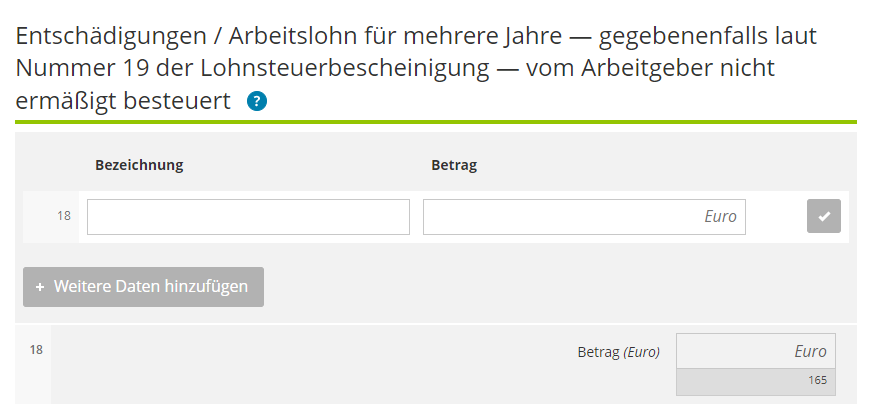
Der Arbeitgeber weist die Entschädigung weiterhin gesondert in der Lohnsteuerbescheinigung aus. Die Fünftelregelung selbst wendet er seit 2025 aber nicht mehr an – die Tarifermäßigung erhalten Sie ausschließlich über die Veranlagung. Prüfen Sie den gesonderten Ausweis daher immer vorab, damit die Abfindung im Steuerbescheid korrekt ermäßigt besteuert wird.


ZEILE IN ELSTERONLINE (2021)
By the beginning of January 2022, no new forms were available in ElsterOnline. However, we assume that these will follow in the next few weeks and that the lines will not change or will not change much.
10. Fazit
Wie Sie sehen konnten, kann die Fünftelregelung die Steuerlast für die Abfindung zum Teil erheblich reduzieren. Das Beispiel 3 und 4 zeigen das es hier auch erheblichen Gestaltungsspielraum gibt. Seit 2025 wendet der Arbeitgeber die Fünftelregelung nie mehr in der Lohnabrechnung an. Die Steuerersparnis erhalten Sie deshalb immer nur über die Einkommensteuererklärung – die Abgabe lohnt sich bei einer Abfindung praktisch immer.
On the subject of severance payments, I also refer to the article: Thinking about the end at the beginning? 3 Basic rules for an appropriate severance payment provision in the GmbH articles of association
We are happy to find out what a cooperation can look like and how we can do it for you in a free and non-binding introductory meeting.
Duration: 30 min.


